Sunday, June 12, 2022

Wuhan, China

 Place: Wuhan, China

Weather: Cloudy in the morning, then showers in the afternoon, 73/82F.

Route: From Wudang Mountains 429km SE on G70.

Population: 12,326,500

Places to visit: Hubei Provincial Museum, Yellow Crane Tower, Donghu National Park, Gude Temple of Hankou, Baotong Temple, Hubei Museum of Art, Wuhan Botanical Garden, Guiyuan Temple, Mo Hill, Hankou Zhongshan Park, Hankow Customs House Museum, Changchun Taoist Temple, Wuhan Revolution Museum.

Images:

Yellow Crane Tower with skyline in the background (from science.org)

Yangtze River (from theculturetrip.com)


Saturday, June 11, 2022

Wudang Mountains, China - UNESCO World Heritage Site

 Place: Wudang Mountains, China

Weather: Intervals of clouds and sunshine, 71/89F.

Route: From Xi'an 357 km SE on G70.

Significance: The earliest temple on mountain was a Tao building from the 7th century. The mountain has been a center of Chinese religion and culture since then. Ming dynasty Emperor Zhu Di directed the construction of many of the buildings on Wudang. Zhu Di was also responsible for the construction of the Forbidden City in Beijing.

Website: UNESCO World Heritage Site

Video:


Images:

Purple Cloud Monastery (from whc.unesco.org)

Purple Heaven Palace (from whc.unesco.org)


Friday, June 10, 2022

Xi'an, China

 Place: Xi'an, China

Weather: Partly cloudy, 66/91F.

Route: From Dengfeng 436 km west on G30.

Population: 12,952,907

Places to visit: Mausoleum of the First Qin Emperor - Terra Cotta Warriors (UNESCO World Heritage Site), Xi'an City Wall, Big Wild Goose Pagoda, Shaanxi History Museum, Xi'an Bell Tower, Xi'an Mosque, Tomb of Emperor Jingdi, Xi'an Museum, Tang Bo Art Museum, Drum Tower, Forest of Stone Steles Museum, Xi'an Banpo Museum, Small Goose Pagoda, Huaquing Palace, Temple of Eight Immortals, Qing Long Si, Lishan National Forest Park, Celebration Palace Park, Daxingshan Temple.

Images:

The Giant Wild Goose Pagoda with modern skyline in the background (from latimes.com)

The Terra Cotta Warriors in the Mausoleum of the First Qin Emperor (from whc.unesco.org)


Thursday, June 9, 2022

Dengfeng, China - UNESCO World Heritage Site

 Place: Dengfeng, China

Weather: Cloudy, 67/82F.

Route: From Qufu 455 km WSW on G1511.

Population: 717,400

Significance: In Chinese literature Dengfeng is known as "The Centre of Heaven and Earth."  It is at the base of the sacred mountain of Songshang. There are many important temples here for Taoism, Buddhism, and Confucianism. There is also a famous astronomical observatory from the 13th century.

Website: UNESCO World Heritage Site

Video:


Images:

Pagoda of Songyue Temple (from whc.unesco.org)

The Gaocheng Observatory (from whc.unesco.org)


Wednesday, June 8, 2022

Qufu, China - UNESCO World Heritage Site

 Place: Qufu, China

Weather: Partly cloudy, 66/94F.

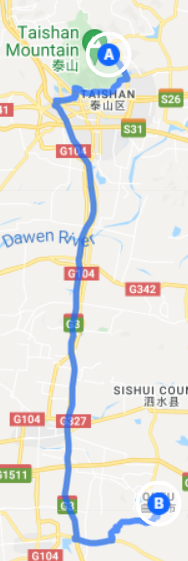
Route: From Taishan 141 km south on G3.

Population: 653,000

Significance: Qufu was the birthplace and home of philosopher Confucius, who has been important to Chinese culture for 2,500 years.  His family lived in a mansion here for 77 generations until the mid-20th century when they left to Taiwan during the Chinese civil war.

Website: UNESCO World Heritage Site

Video:

Images:

Confucius Temple (from whc.unesco.org)

Confucius' tomb (from whc.unesco.org)


Tuesday, June 7, 2022

Taishan, China - UNESCO World Heritage Site

 Place: Taishan, China

Weather: Generally sunny, 61/85F.

Route: From Yinxu 323 km east on G22.

Significance: Taishan has been an object of mountain worship for over 2,000 years.  The first recorded emperor to have a ceremony here was Huang Di of the Qin Dynasty in 219 BC. The top of the mountain is thought to be the entrance to heaven. 

Website: UNESCO World Heritage Site

Video:

Images:

Pilgrims climbing to the top of Taishan (from whc.unesco.org)

There are inscriptions on the rocks along the path, some from thousands of years ago (from whc.unesco.org)


Monday, June 6, 2022

Yin Xu, China - UNESCO World Heritage Site

 Place: Yin Xu, China

Weather: Mostly sunny skies, 64/93F

Route: From Ping Yao 364 km SE on G2516.

Significance: This is the oldest site we've visited in China. These are ruins of the Bronze era capital of the Shang dynasty, which existed from 1300-1046 BC. Oracle bones found there are among the earliest examples of Chinese writing. The Shang Dynasty is known for being a center of science and art.

Website: UNESCO World Heritage Site

Images: 

There are burials of chariots with human remains, thought to be sacrificial (from whc.unesco.org)

Oracle bone with some of the earliest evidence of Chinese writing (from whc.unesco.org)